Buying acreage in Snohomish can feel like the best of both worlds: more space, more privacy, and room to use your property in a way that fits your lifestyle. But with that extra space often comes extra responsibility, and the monthly cost of ownership can look very different from a home on a smaller in-town lot. If you are planning for a Snohomish acreage purchase, it helps to understand the ongoing expenses before you fall in love with the land. Let’s dive in.
Why acreage costs work differently
Acreage homes in Snohomish County often come with more owner-managed upkeep than a typical suburban property. The county notes that it has not adopted a property maintenance code, and issues involving private roads or easements are generally civil matters rather than something the county enforces.
That means you may be responsible for more of the day-to-day and long-term site care yourself. On many rural properties, ownership can include managing drainage, fencing, weeds, pasture areas, soil conditions, and access routes in addition to the house itself.
Start with systems, not finishes
When you budget for an acreage home, it is smart to focus first on the systems that keep the property functioning. A new kitchen backsplash can wait. A failing septic system, drainage issue, or shared-road problem usually cannot.
For many buyers, the most important question is not just, “Can I afford the purchase price?” It is, “Can I comfortably afford the property’s ongoing cost structure?” That answer often depends on whether the home has a private well, septic system, long driveway, culvert, or private-road access.
Electricity and utility setup costs
If the property uses Snohomish PUD electric service, current residential rates include an energy charge of 10.613 cents per kilowatt-hour plus a daily base charge tied to panel size. For a typical single-family medium service, the daily base charge is $0.80, which works out to about $24 per month before usage.
It also helps to account for service-related fees when you move. Snohomish PUD lists a $15 account service charge and an $80 same-day reconnection fee for electric or water service. Those may not be large compared with a mortgage payment, but they are still part of the real move-in cost.
Property taxes deserve an early estimate
Property taxes should be part of your ownership plan from the beginning. Snohomish County updates assessed values annually, typically mails tax statements in February, and sets first-half taxes due April 30 and second-half taxes due October 31.
For 2026, the county reports an average tax rate of $8.1949 per $1,000 of assessed value. Using that average, a home assessed at $1,000,000 would imply about $8,194.90 in annual property tax before exemptions and tax-code-area differences. Because actual taxes vary by location and assessed value, it is worth modeling this number early rather than treating it as an afterthought.
Well water means ongoing testing
Some Snohomish acreage properties rely on private wells instead of public water. If that is the case, Washington State Department of Health guidance says well owners are responsible for testing their own water.
The department recommends annual testing for coliform bacteria and nitrate. It also recommends testing for arsenic twice while you own the well, and notes that arsenic testing usually costs about $20 to $35. In practice, that means your water budget should include routine testing and any added lab work needed for site-specific concerns.
Septic is a major long-term expense
For acreage buyers, septic is one of the most important systems to evaluate. Snohomish County says more than 78,000 county homeowners rely on septic systems, so this is a common part of rural and semi-rural ownership in the area.
The county points owners to system-specific inspection frequency, septic records, and a free Savvy Septic workshop. General maintenance guidance cited in the research indicates septic systems should usually be inspected every 1 to 3 years and pumped every 3 to 5 years.
Routine maintenance is often estimated at $250 to $500 every 3 to 5 years. Repairs or replacement for a failing conventional system can range from $5,000 to $15,000, and pumps or controls often need replacement in the 10- to 20-year range.
The good news is that Snohomish County’s Savvy Septic program may help with some of those costs. The county says rebates are available for septic inspections, riser installation, pumping, and minor repairs, and that grants and low-interest financing may be available for major repairs.
Driveways, culverts, and drainage add up
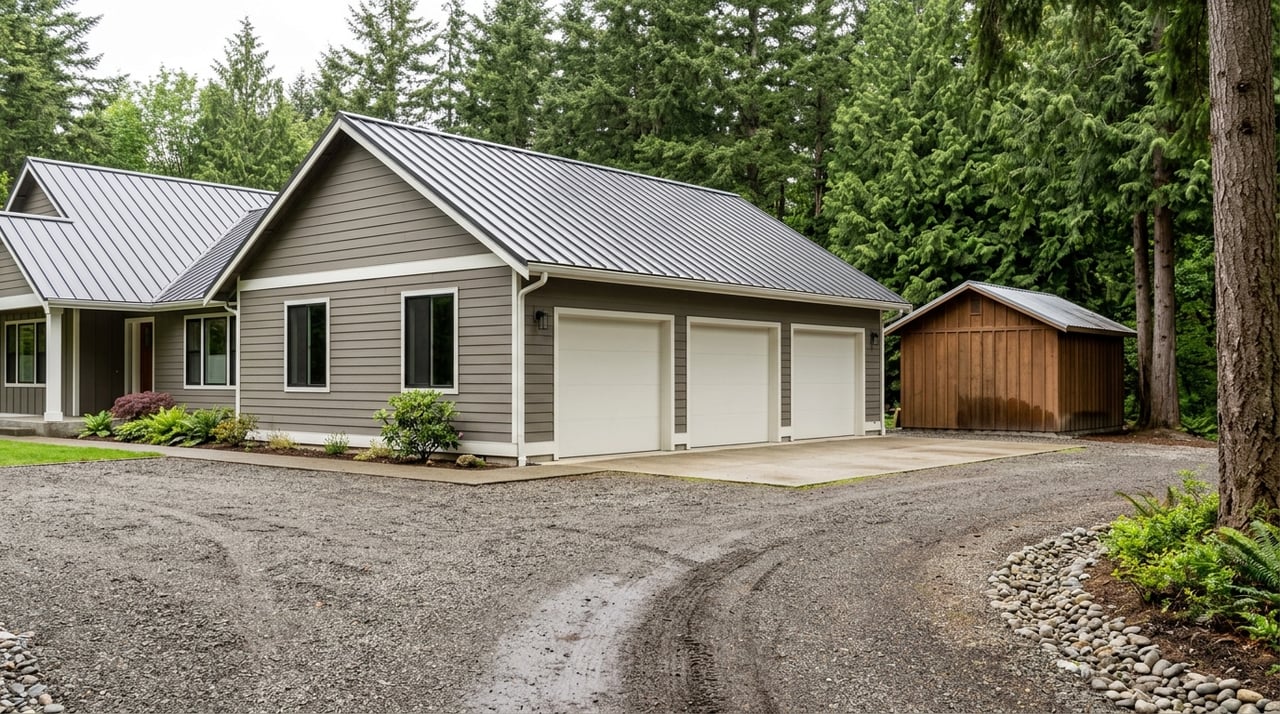
One of the most overlooked parts of acreage ownership is access infrastructure. A long gravel driveway may look simple, but over time it can need grading, fresh gravel, culvert cleaning, and drainage work.
This matters in Snohomish because WSU’s rural stormwater guidance notes that compacted gravel driveways and other hard surfaces can create runoff and ponding problems. In other words, drainage is not just a one-time installation issue. It is an ongoing maintenance category.
If work affects county-road access, permits may also come into play. Snohomish County says legal access is required for any new connection from a county road to a property, and public-road access requires a driveway or access permit.
The county’s access page lists a $360.50 access permit fee, while a county fee bulletin lists a $350.00 access or driveway permit fee. Because those figures do not match exactly, buyers should verify the current amount before relying on a specific number.
The county also notes that driveway or site work can trigger more than one permit-related charge, including drainage and grading review fees. That is why it helps to think beyond just the visible driveway surface and ask how the whole access system works.
Private roads need a clear plan
If your acreage property uses a private road or shared easement, make sure you understand how maintenance is handled. Snohomish County says private-road disputes and easement issues are civil matters, which means the county typically does not step in to manage those disagreements for owners.
That makes documentation especially important. A road-maintenance agreement, HOA budget, or shared reserve can make a big difference in how predictable your future costs will be.
Before you buy, ask who maintains the road, how costs are split, how often work is done, and whether there is a reserve for larger repairs. Those details can affect both your budget and your peace of mind.
Land upkeep is part of the ownership cost
Acreage homes often come with a broader maintenance list than buyers expect at first. WSU Extension’s small-acreage guidance treats fencing, pasture management, weed management, soil health, land conservation, manure and mud management, and responsible pesticide use as normal rural-property topics.
Even if you do not plan to use every part of the land right away, you will still want a plan to keep the property functional and manageable. Depending on the parcel, that may include mowing, brush control, drainage upkeep, fence repair, fuel, rented equipment, or hired help.
This is one reason acreage buyers should budget for land stewardship just as seriously as they budget for the home’s interior systems. The outdoor maintenance side of ownership is often where the surprise costs show up.
Records to request before you buy
If you are serious about a Snohomish acreage property, ask for records early. Good documentation can help you estimate near-term costs and spot red flags before closing.
Request items such as:
- Well history
- Latest water test results
- Septic as-builts
- Septic inspection reports
- Road-maintenance agreements
- Driveway or culvert permits
- Any records related to drainage work or access improvements
Snohomish County also points owners to its Online RME database for septic records and says the health department can help with septic permitting, operation, maintenance questions, and certified contractors. That local paper trail can be extremely useful when you are trying to understand what you are really buying.
Plan ahead for future improvements
If you hope to add onto the property later, do not assume the existing systems will support your plans. Snohomish County says rural properties need an approved well and on-site septic system for construction of a residence or buildings with plumbing.
That means a future addition, a shop with plumbing, or another improvement could trigger utility and permitting costs. Verifying water and septic capacity early can help you avoid an expensive surprise after you move in.
A simple Snohomish acreage reserve checklist
A reserve fund can make acreage ownership much less stressful. Instead of reacting to every repair as an emergency, you can plan for recurring and long-term expenses from the start.
Here is a practical checklist to build into your budget:
- Electricity usage and the monthly PUD base charge
- Utility setup or reconnection fees when applicable
- Annual property taxes based on assessed value and tax code area
- Annual well-water testing and any additional lab work
- Septic inspections, pumping, and minor repairs
- A larger septic reserve for pumps, controls, or system replacement
- Driveway grading and gravel replenishment
- Culvert cleaning or replacement
- Drainage fixes and related permits if needed
- Shared private-road maintenance contributions
- Fencing, mowing, brush control, and general land-management costs
The exact numbers will vary from one property to another. Still, this kind of framework can help you compare acreage homes more realistically and avoid underestimating the true cost of ownership.
Why local guidance matters
Acreage homes are not one-size-fits-all, even within Snohomish. Two properties at a similar price point can have very different ongoing costs based on access, topography, water, septic, and how much site maintenance they require.
That is why it helps to look beyond the listing photos and ask practical questions early. A property with a well-maintained septic system, documented road agreement, and manageable drainage setup may be easier to budget for than a cheaper property with unknown systems and deferred maintenance.
When you understand the long-term cost picture, you can make a more confident decision and choose a property that fits both your lifestyle and your finances. If you are comparing acreage homes in Snohomish and want help looking at the details behind the listing, connect with Jennifer Colwill for practical guidance tailored to your goals.
FAQs
What ongoing costs should I expect with a Snohomish acreage home?
- Common recurring costs can include electricity, property taxes, well-water testing, septic maintenance, driveway and drainage upkeep, private-road contributions, and land-management expenses like mowing, brush control, and fencing.
How much are property taxes for acreage homes in Snohomish County?
- Snohomish County’s 2026 average tax rate is $8.1949 per $1,000 of assessed value, so a property assessed at $1,000,000 would imply about $8,194.90 in annual taxes before exemptions and area-specific differences.
How often should private well water be tested for a Snohomish property?
- Washington State Department of Health recommends annual testing for coliform bacteria and nitrate, plus arsenic testing twice during your period of ownership.
What septic costs should buyers plan for on Snohomish acreage?
- Buyers should plan for regular inspections, pumping every few years, minor repairs, and a longer-term reserve for larger items such as pump, control, or system replacement.
Why do drainage and driveway costs matter on rural Snohomish properties?
- WSU guidance notes that compacted gravel driveways and other hard surfaces can cause runoff and ponding, so grading, gravel replacement, culvert work, and drainage fixes are often recurring maintenance items.
What records should I request before buying a Snohomish acreage home?
- Ask for well history, water test results, septic as-builts, septic inspection reports, road-maintenance agreements, and any driveway, culvert, or drainage-related permits and records.